Refrigerator Repair
Fresh food side warm, freezer still cold: what a Los Angeles heat wave exposes
Written byYuki TanabeRefrigeration technician — controls and sensors · 18 years in the trade
On a built-in Sub-Zero, one compartment climbing while the other holds points at that side of the system — its evaporator, its fan or its defrost circuit. What to check in an Encino or Westside kitchen before calling anyone.
The call that arrives in clusters every summer sounds the same each time: the freezer is rock solid, the refrigerator side is at 50°F and climbing, and nobody has touched a setting. In Encino it starts the week the Valley first reaches a hundred degrees. On the Westside it arrives a fortnight later and more slowly. The pattern is worth understanding because it decides what is actually wrong.
Two systems in one cabinet
Most built-in Sub-Zero cabinets — the full-height side-by-side machines, the column units beside them, and integrated cabinets behind custom panels — run two separate sealed systems, one for refrigeration and one for the freezer. Each has its own compressor, its own evaporator and its own fan. They share a cabinet, a control board and one condenser bay at the bottom.
That architecture is why a Sub-Zero holds temperature better than a domestic refrigerator, and it is also why the symptom above is so specific. A freezer that still reaches zero proves the power supply is fine, the condenser is at least partly working and the control board is alive. It says nothing at all about the fresh-food circuit.
So the fault is on the side that is failing, and there are only a handful of candidates.
What it usually turns out to be
Ordered by how often each one turns up on this particular route:
- Condenser choked with dust. Both systems reject heat through one coil in the plinth. Half-blocked, it copes in April and stops coping at a hundred degrees — and the weaker circuit gives up first, which is usually the fresh-food side.
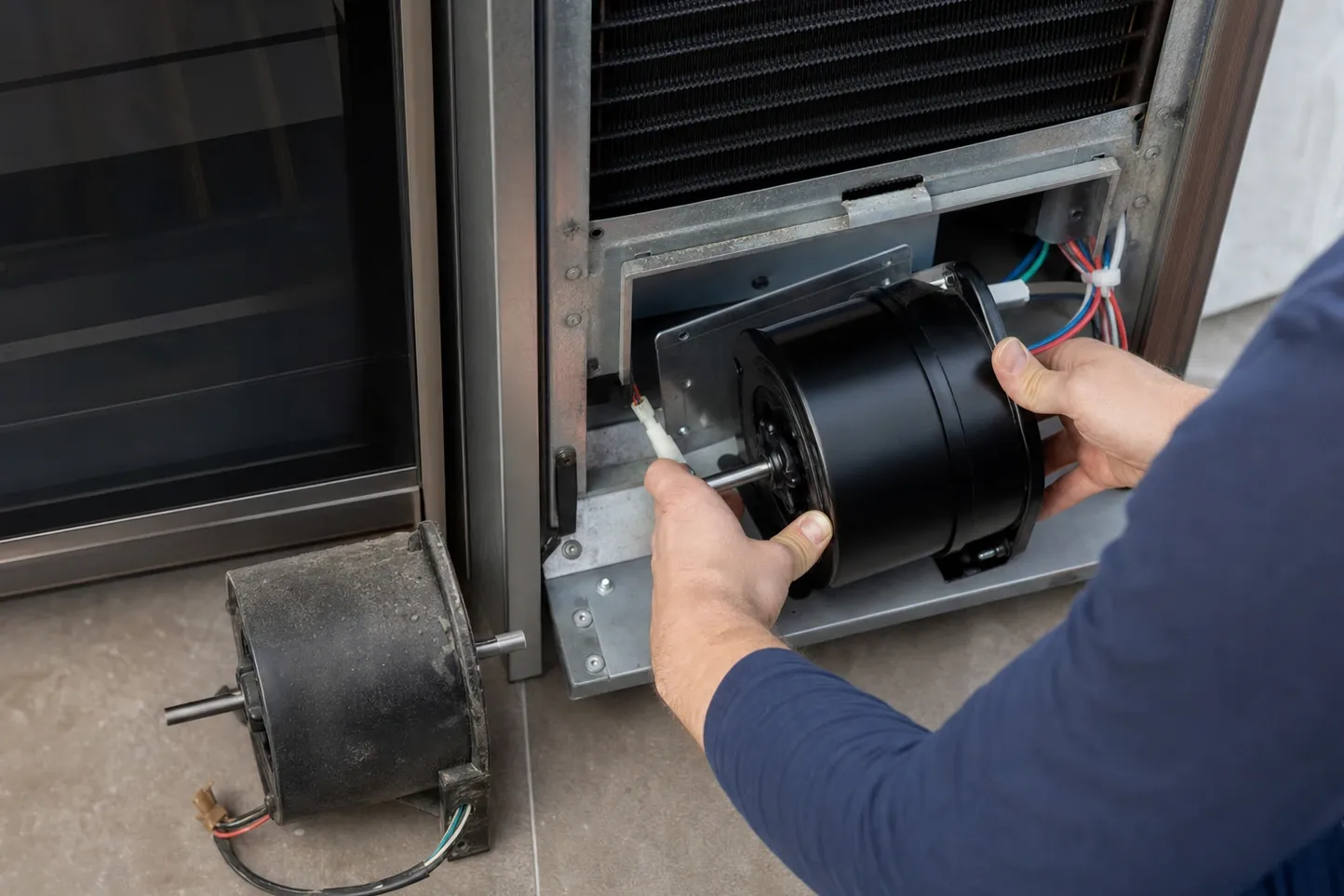
- Condenser fan failing. Same effect, arriving faster. A fan that only spins up sometimes, or turns slowly with a bearing rumble, cannot move enough air across the coil in a hot kitchen.
- Fresh-food evaporator fan. If air is not moving inside the compartment, the evaporator gets cold, the cabinet does not, and the freezer carries on regardless. This is the classic version of the complaint.
- Defrost fault on that circuit. A failed heater or terminator lets the evaporator ice over. Airflow drops to nothing and the compartment climbs while the compressor runs continuously.
- Damper or air-duct problem on cabinets where the two compartments share managed airflow — the vent stops opening, and one side loses its supply.
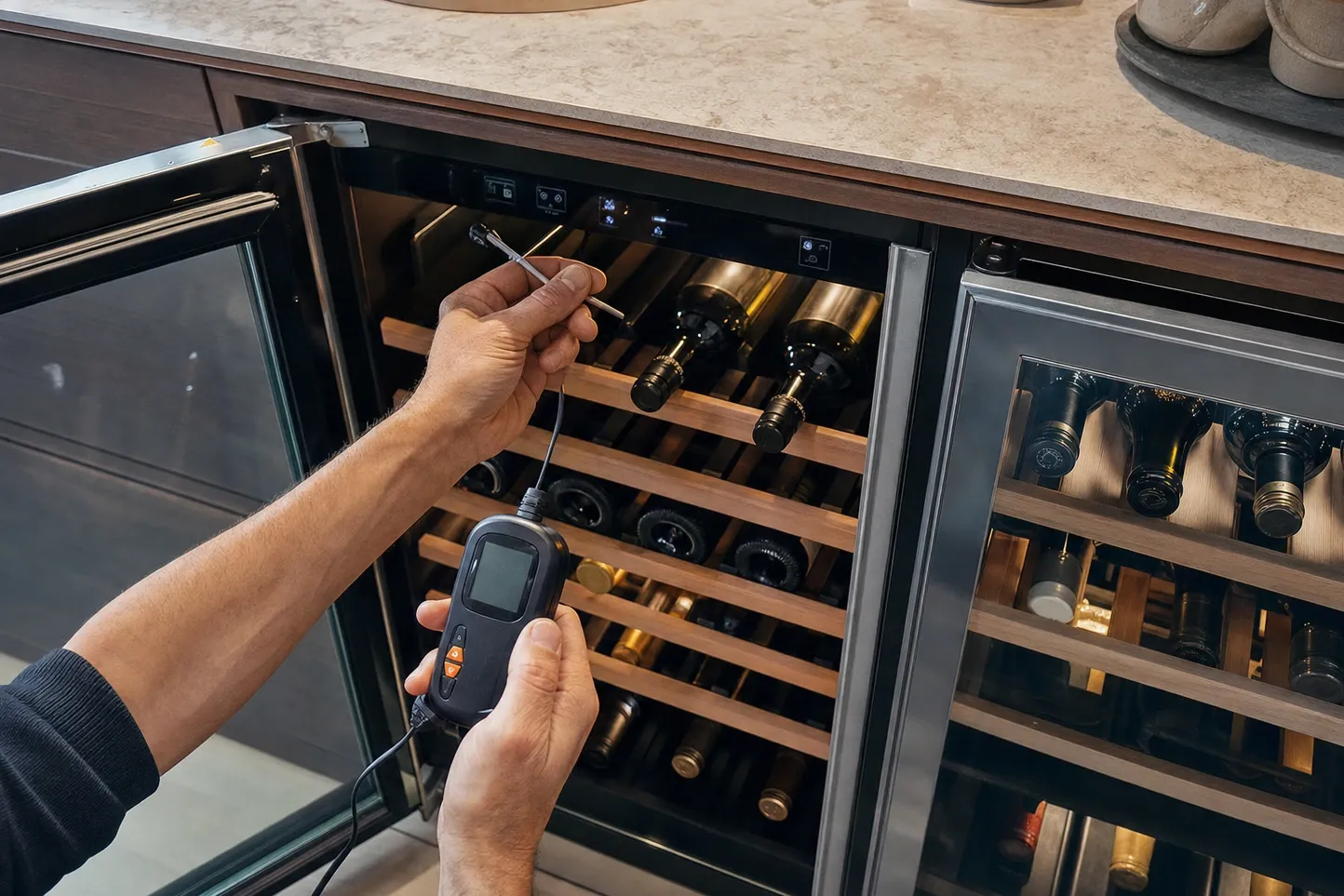
- A sensor reading badly. The compartment is warm, the control thinks it is cold and never asks for more cooling. Rarer, but cheap to fix and easy to prove with a probe.
Notice what is not on that list: the compressor. A dead compressor on the fresh-food circuit is possible, and it does happen, but it is far down the list of first explanations — and it is the one a customer is most often told over the phone by someone who has not looked.
What to check before anyone comes out
Four things, none of which need tools:
- Pull the lower grille and look at the coil. A grey felt of dust across the fins is the single most common cause of a summer failure in a Valley kitchen. Vacuum it gently, including the fan grille behind it. Do not wash it, do not straighten fins.
- Listen at the plinth with the door open. You should hear a fan running in the condenser bay when the compressor is on. Silence, or a rumble that rises and falls, is a finding worth reporting.
- Open the fresh-food door and feel for air. With the door open the interior fan normally stops, so press the door switch or watch for movement in a strip of tissue at the vent before it cuts. No airflow at all points at the evaporator fan or an iced evaporator behind the rear panel.
- Check the seal. Close the door on a sheet of paper and pull. If it slides out with no drag, the gasket is letting warm room air in — which will not on its own take a cabinet to 50°F, but it will stop a healthy one from recovering.
Write down what each compartment reads and what it is set to. Two numbers per side, measured with anything other than the built-in display, are worth more to whoever answers the phone than any description of the noise.
When the sealed system really is the problem
If the condenser is clean, both fans run, the evaporator is clear of ice and the compartment still will not come down, the readings start pointing at the sealed system — a refrigerant loss, a restriction in the capillary, or a compressor that is turning but not pumping. That is gauge work. It is also the point at which the honest conversation about the age and condition of the whole cabinet belongs, because a sealed-system repair on a twenty-year-old unit is a different decision from replacing a fan motor.
What matters is the order. Gauges go on after airflow, defrost and controls have been ruled out, not before. A technician who opens the sealed system first has skipped the cheap answers, and the cheap answers are most of the calls.
When it is worth calling someone out
Call when the fresh-food side has been above 40°F for four hours or more, when ice keeps returning on the rear panel after you clear it, when the compressor never stops, or when you have cleaned the condenser and nothing changed overnight. Any of those is past the point where waiting improves the outcome.
A visit costs $89. That buys the journey out and the whole diagnosis, and it comes off the repair if you approve the work — so the diagnosis costs the same whether the answer is a fan motor or a sealed system, and you get the price before anything is opened up.
Follow-ups
- Should I turn the refrigerator colder while I wait for a visit?
- No. Turning the dial down on a unit that already cannot reach its set point only makes the compressor run longer for the same result, and on a dual-system cabinet it can drive the freezer side into over-cooling. Leave the settings alone, keep the doors shut and move anything you care about into the side that is still holding.
- The freezer is fine, so the compressor must be fine — why is a visit needed?
- On most built-in Sub-Zero cabinets there are two sealed systems, so a healthy freezer says nothing about the fresh-food side beyond ruling out the shared electrical supply. The fault is on the circuit that is failing: its evaporator, its fan, its defrost heater or its damper.
- How long can food stay in there?
- Above 40°F the food is the clock, not the repair — a few hours is the usual guidance for a full load, less in a hot kitchen. Move what matters into the freezer side or a cooler and stop opening the door to check.
- Does clearing the condenser myself help?
- Often, and it is the one job an owner can safely do: grille off, vacuum the coil and the fan grille, nothing bent, nothing washed. If the cabinet recovers overnight the condenser was the problem. If it does not, you have at least removed a variable before anyone charges for a visit.