Refrigerator Repair
What “discontinued” actually means for a Sub-Zero part
Written byYuki TanabeRefrigeration technician — controls and sensors · 18 years in the trade
What a supplier is telling you when a part is no longer catalogued, what a technician does next, and the point at which it genuinely decides the fate of a cabinet.
The word almost never arrives from the manufacturer. It reaches a kitchen second-hand, from a parts counter or from somebody repeating what a counter said, and by then it has hardened into a verdict on the whole appliance. What we usually find, on a cabinet old enough for anyone to be saying it out loud, is that the verdict was passed on a number rather than on a part — and the number was the wrong one to be searching.
The model number mostly describes the outside of the cabinet
Sub-Zero’s service documentation for the 600 Series makes this plain in a single note. Twenty model numbers cover seven basic configurations, and the character after the backslash records nothing but the exterior treatment: a framed door with a handle, a door built to take an overlay panel, or stainless steel. The manual states that functional parts are common to each configuration — a 601R/F, a 601R/O and a 601R/S draw on the same hardware behind the door.
So a catalogue can return nothing for the badge on the front of your machine while the component you need is listed three model numbers away, under a cabinet that differs from yours only in what its door is faced with. “Nothing listed for that model” and “nothing made any more” are two different sentences, and only the second one ends a repair.
The serial number is where the answers are actually filed
The same documentation is explicit that warranty and service information is arranged and stored under the unit’s serial number, and it asks that the model and serial both be to hand before anyone contacts the factory or a parts distributor. That is not administrative fussiness. Cabinets sold under one model number are not always built identically across a production run, and the serial is the only thing that resolves which build is standing in the opening.
The plate carries more than the serial, too: the manufacture date as a month and a year, the refrigerant charge, the total amps and the refrigerant type. On the older built-ins around here that last line is frequently the most consequential thing printed on the machine. There is more on all of it in what the rating plate says about the age of the machine, and photographing the plate is a two-minute job that pays for itself every time the cabinet needs something.
What substitutes, and what refuses to
The manufacturer’s own warranty paperwork gathers the functional hardware into a single group, and it is a useful group to have in mind: ice makers and water valves; hinges, closers and cams; fan motors with the blades on them; the fan and light switches; defrost terminators; the heaters that serve a defrost cycle and a drain; pans, tubes and wiring; light sockets; and the electronic control components that run all of it. These are the pieces shared across configurations, so they have the largest number of cabinets keeping them alive in circulation.
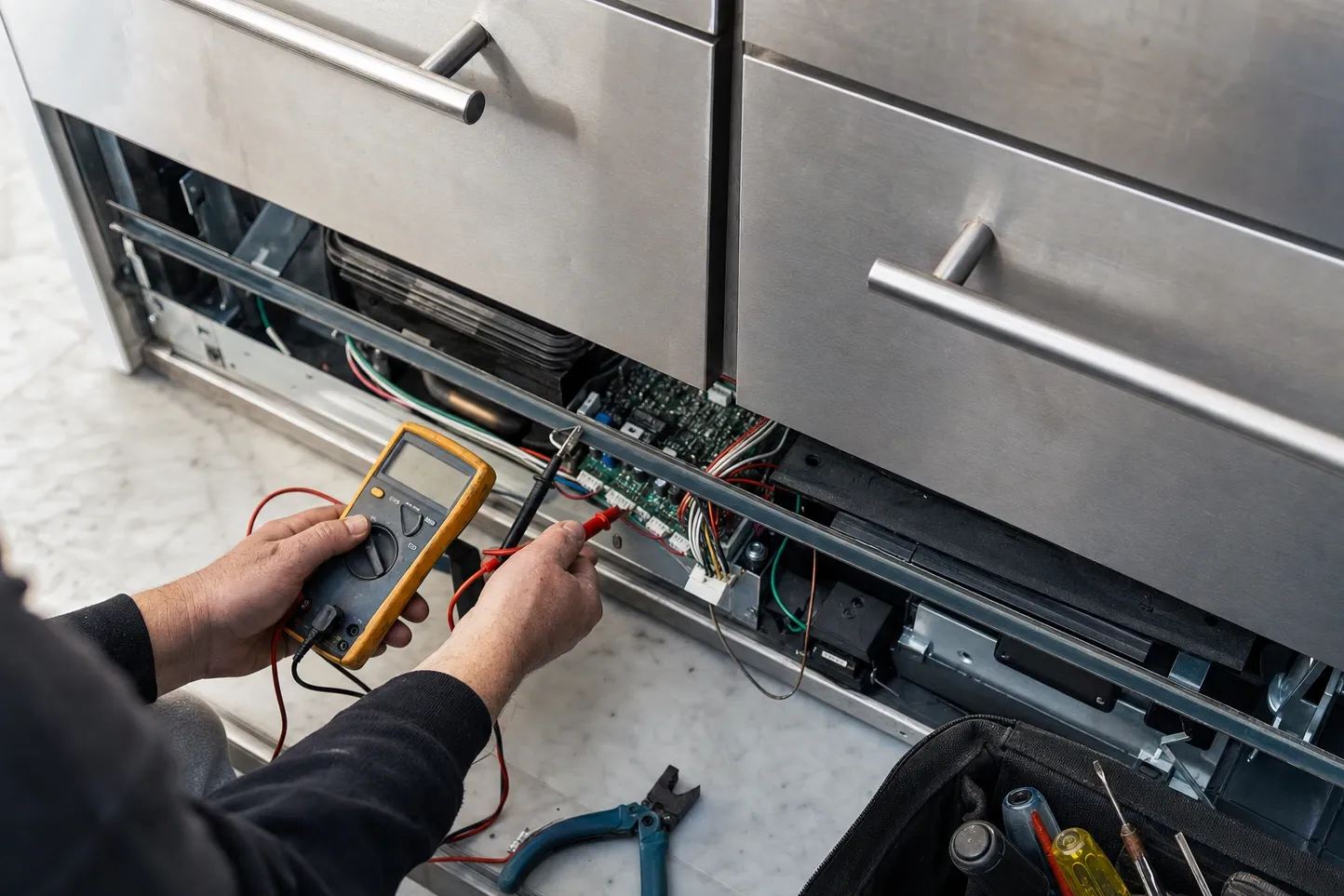
Sensors are the most forgiving case of the lot, because they are specified rather than styled. The control is watching for a defined resistance at a known temperature — thirty to thirty-three thousand ohms at freezing point on the built-in thermistors — which means a candidate can be measured against the figure before it goes anywhere near the machine.
What refuses to substitute is anything the cabinet wears. A stainless door in one width, a trim frame, a louvre grille, a moulding inside the liner: each of those was made for one machine in one finish, and nothing else fills the hole it leaves. Electronics written for a short production run belong in the same category. Older built-ins sit thick on the ground from Encino down to the flats, and it is almost always a cosmetic or a board question when a part search here truly runs out of road.
Where the word does decide the machine
There is one area where it carries full weight. The manufacturer groups the compressor, condenser, evaporator, filter-drier, heat exchangers and the tubing that carries refrigerant as sealed-system parts, and its service instructions require the high-side filter-drier to be replaced whenever that system is opened at all. Work of that kind depends on components being available as a set, and the rating plate can complicate it further: a plate reading R-12 tells you the original refrigerant is no longer produced for new equipment, which changes the terms of the job before a single figure is discussed.
That is the conversation the repair-or-replace scenarios were written for, and the comparison to run first is the one on a compressor quote against the price of a new built-in. A cosmetic part that cannot be found is an annoyance. A sealed-system part that cannot be found is a decision.
What to do the moment you hear it
Get three things written down: which part, in plain words; which number was searched; and the model and serial off the plate. Most of the time that is enough to turn a verdict back into a question, and the question has an answer more often than the verdict suggests. Where a genuine replacement exists, factory-approved parts are what go in.
The diagnosis costs $89 and it buys measurements rather than opinions — what has actually failed, what specification it has to meet, and whether the machine is worth the money before anything is ordered. Read the plate to Sub-Zero Repair Pro Los Angeles on (310) 844-1973 and start there.
Follow-ups
- A technician told me the part is discontinued. Is that the end of the repair?
- Rarely on its own. The word describes a catalogue entry, not a shortage, and the number searched is very often the whole cabinet rather than the component inside it. Ask which part, in plain words, and which number was typed in. Sub-Zero Repair Pro Los Angeles will take both down on (310) 844-1973 before anyone writes the machine off.
- Why does everybody keep asking me for the serial number?
- Because that is the reference the manufacturer files a cabinet under. Its own documentation says warranty and service information is arranged by serial, and asks owners to have model and serial together before contacting the factory or a parts distributor. Two machines can wear one model number and differ inside; the serial separates them.
- Which parts genuinely disappear, and which ones almost never do?
- Whatever the cabinet wears goes first. A door in one width and finish, a trim frame, a louvre grille, an interior moulding: each was made for a single machine. Functional hardware survives far longer, because the manufacturer shares it across configurations, so several model numbers keep one component in circulation at once.